Many opera companies are working towards full sustainability, and Glyndebourne is among those aiming to be a force for good, according to a new documentary.
A night at the opera is not typically equated with restraint, instead conjuring images of chandelier-filled theatres and arias performed in exquisite costumes against transportative stage sets. Yet, recent years have seen opera companies across the globe make a determined effort to operate more sustainably, implementing numerous strategies in a bid to reduce their carbon emissions and overall impact on the planet.
This is, in part, the result of climate activists, who have increasingly targeted the arts and entertainment industries over the past few years with the aim of drawing greater attention to their cause. At the end of 2022, for instance, responding to mounting protests, the Royal Opera House cut ties with its long-time sponsor, the oil giant BP. Yet, it is also a response to the shifting expectations of audience members: according to a UK study conducted in 2022, 77% of audience members now expect theatres to address the climate emergency in their work – and opera houses are no exception.
The pandemic, while posing innumerable difficulties for the live entertainment industry, also offered an important pause for reflection. It was during this time that a number of UK theatre-makers joined forces with sustainability experts to conceive the Theatre Green Book, a publication setting a common standard for sustainable theatre production, and providing guidance on how best to achieve it. Divided into three volumes – sustainable productions, sustainable buildings and sustainable operations – spanning the many facets of what it means to run a theatre, the acclaimed guide has already been widely implemented.
Art, opera, nature [has always been] a core trinity for Glyndebourne – Phil Boot
A key collaborator in the creation of the Theatre Green Book was the historic East Sussex opera house Glyndebourne, renowned for its summer festival which draws thousands of opera lovers to the stately home’s verdant grounds each year. Glyndebourne has been forging a path towards greater sustainability in opera for some time. “Art, opera, nature [has always been] a core trinity for Glyndebourne,” explains its archivist Phil Boot in a new BBC documentary Take Me to The Opera: The Power of Glyndebourne.
In 2012, executive chairman Gus Christie oversaw the installation of a 67m (220ft)-tall wind turbine on a hill adjacent to the opera house, which between then and 2022 has generated the equivalent of 102% of the electricity used by the company in the same period. The turbine serves as an important statement of intent for Glyndebourne. Alison Tickell, the founder and chief executive of Julie’s Bicycle, a non-profit organisation dedicated to mobilising the UK arts and culture sectors in a fight against climate change, says in the documentary: “I know that many opera companies… don’t have the luxury of space. But [the turbine] still remains a beacon for us all [demonstrating] that climate action really matters.”
 Getty Images
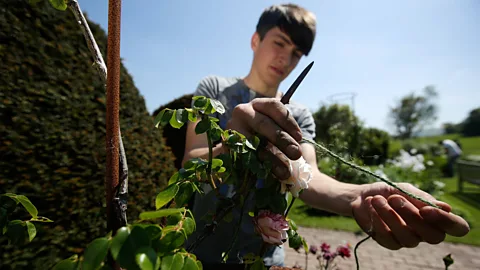
Glyndebourne has innovated in sustainable practice in the years since. In 2021, it joined the global Race to Zero, pledging to halve its direct carbon emissions by 2030, and to reach net zero by 2050. “We are zero waste to landfill now, so any waste we have goes down to [an] incinerator, which provides power for local homes,” Christie says of some of the measures he and his team have taken to achieve this. “We compost all our garden waste, we recycle as much of our stage-set material, costumes, props [as we can]. We have about 32 electric vehicle charging points [for visitors] which are all charged from the wind turbine.” They are drawing from their resources in other ways, too: by the end of this year, they predict, all water served at Glyndebourne will come from the property’s own natural spring, while plants grown in their gardens are being used to produce dyes for the company’s costumes. “Rivers around the world are polluted by dyes a lot,” says dye room supervisor Jenny Mercer in the documentary. “This way everything goes back into the ground.”